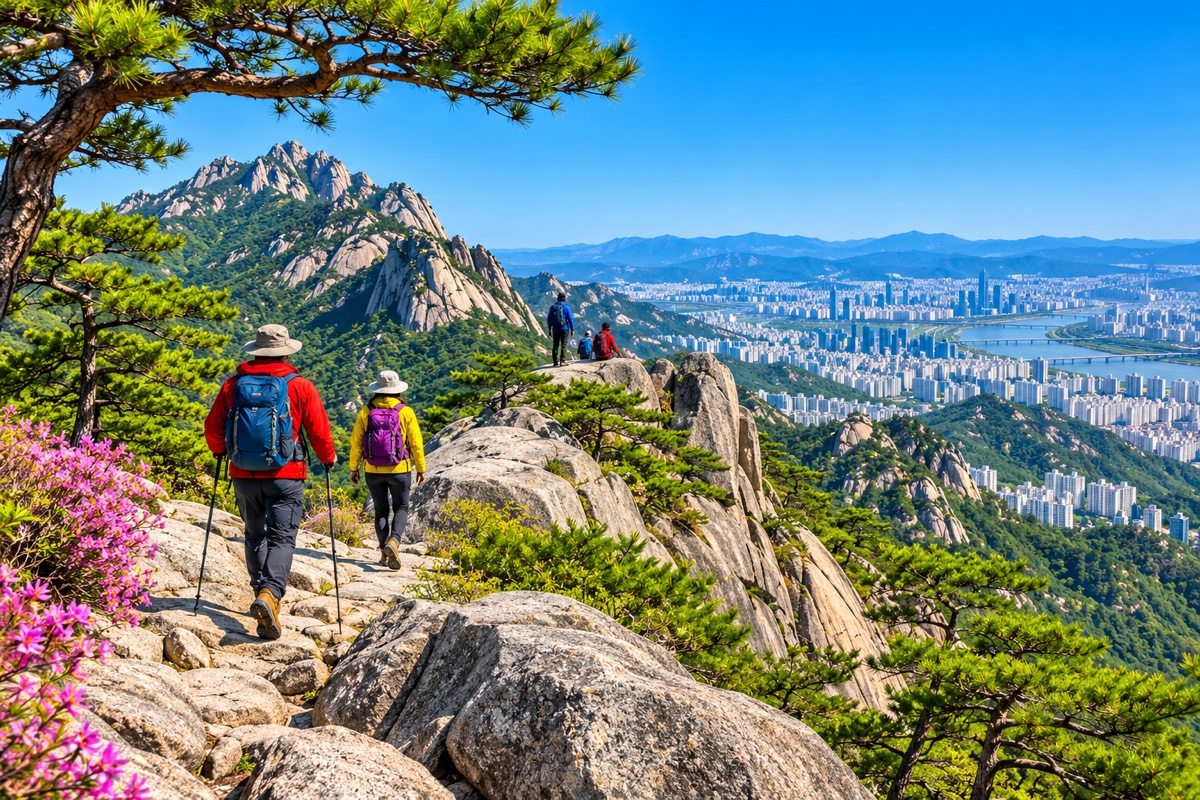
Bukhansan is the big granite mountain on Seoul's northern edge, and you can hike it with nothing more than a T-money card.
The most popular beginner route to the top, Baegundae (836 m), starts at the Bukhansanseong trailhead, about a 15-minute bus ride from Gupabal Station on Line 3, and takes most people around 4 to 5 hours round trip.
Bukhansan National Park has no entrance fee.
Our family has climbed it in every season, with kids and without, and this is the route we send visiting friends on.
It is not a walk in the park.
The last section is steep rock with steel cables, but with decent shoes and an early start, it is very doable.
How do I get to Bukhansan from central Seoul?
Take Line 3 to Gupabal Station and leave by the exit for the bus stops toward Bukhansanseong.
Several buses go to the Bukhansanseong stop; ask the driver or look for hikers in boots and you will be in the right place.
On weekend mornings, the bus is full of hikers, which makes it easy.
From the bus stop, walk up the road through a small village of restaurants and outdoor shops to the trailhead and the national park office.
| Leg | Time (approx.) | Tip |
| Central Seoul to Gupabal (Line 3) | 30–45 min | Board toward Daehwa |
| Gupabal to Bukhansanseong bus stop | 15–20 min | Weekend buses fill with hikers |
| Trailhead to Baegundae summit | 2.5–3 hours up | Steep cable section near the top |
| Summit back to trailhead | 2 hours down | Knees hurt more going down |
How hard is the Baegundae route?
The first hour is a wide, gentle trail along a stream.
Then it climbs steadily through forest to the old fortress gate at Wiseongmun.
From there, the final stretch is bare rock with fixed steel cables and railings.
It feels dramatic, and it is busy on weekends, but there is no technical climbing.
If you are afraid of heights, the view from the fortress gate is already excellent, and turning around there is a perfectly good day out.
We did exactly that with our kids the first few times.
What should I wear to hike Bukhansan?
Koreans take hiking clothes seriously, and you will see full outdoor outfits.
You do not need that, but you do need:
1. Shoes with real grip. The granite is smooth and slippery, especially when wet or icy.
2. Layers. It is windy and much colder on the summit than in the city.
3. Water and a snack. There are no shops above the trailhead area.
4. Gloves for the cables, especially in winter, when the steel is freezing.
In winter, after snow, many local hikers use simple crampons that slip over their shoes.
They are sold in the outdoor shops on the way to the trailhead.
Without them, icy rock on the upper section is genuinely dangerous.
When is the best time to hike Bukhansan?
Autumn is the most beautiful and the most crowded.
Spring is lovely too.
Winter has the clearest views and fewer people, but icy patches.
Summer is hot and humid, so start very early.
On any weekend, start before 9 a.m. to avoid long lines on the cable section.
Weekdays are much quieter.
What rules should I know in Bukhansan National Park?
Stay on marked trails; off-trail areas are closed to protect the park, and rangers do patrol.
Some trails close temporarily during dry seasons for fire prevention, usually in spring and late autumn, so check the Korea National Park Service website before you go.
Smoking and cooking are not allowed, and drinking alcohol is banned in designated areas, including peaks.
Trails close to new entries in the afternoon so hikers are not caught in the dark; the exact time changes with the season.
Carry your trash down.
What do Koreans eat after a hike?
The restaurants at the bottom of the trail are part of the experience.
Seafood pancakes (haemul pajeon), tofu stews and acorn jelly with a bowl of makgeolli are classic after-hike food.
On a cold day, a hot bowl of soup there is the best part of the trip.
Is Bukhansan safe for kids or beginners?
The lower trails are fine for families.
For young children, aim for the fortress area or one of the valley trails rather than the summit.
Older kids who have hiked before can manage Baegundae on a dry day with an adult close by on the cable section.
If the rock is wet or icy, we skip the summit entirely.
What is the route, step by step?
Here is the way we walk it, with rough times for an unhurried beginner.
1. Bukhansanseong bus stop to the trailhead and park office: about 15 minutes through the village.
2. Trailhead to the stream valley and the first rest area: about 40 minutes on an easy path.
3. The forest climb to Baegunbong Saddle: about an hour, steady and rocky, with steps.
4. Saddle to Wiseongmun, the fortress gate: about 20 minutes, steeper.
5. Wiseongmun to the Baegundae summit: about 20 minutes on bare rock with cables.
On the way down, follow the same route unless you have a good map and plenty of daylight.
Signs are in Korean and English at junctions, and Naver Map shows the trails.
What will I see from the top?
On a clear day, the summit shows Seoul spread out below, the Han River, the city's other mountains and the granite peaks of Insubong and Mangyeongdae right next to you.
The Korean flag flies on the summit rock, and there is usually a line of hikers waiting for a photo.
Winter days after a cold front often have the clearest air of the year.
Fine dust days, more common in late winter and spring, can hide the view, so check the air quality forecast as well as the weather.
Are there easier hikes in Seoul if Bukhansan is too much?
Yes.
Inwangsan, near Gyeongbokgung, is a short climb along the old city wall with a big city view.
Namsan is a gentle walk to N Seoul Tower.
Achasan, in eastern Seoul, is a popular sunrise hike that takes about an hour.
All three are reachable by subway, and we often take visitors there first before trying Bukhansan.
What should I bring in my daypack?
| Item | Why |
| 1 liter of water per person | No shops on the trail |
| Snack and kimbap | Lunch at the fortress gate |
| Warm layer and windbreaker | Summit is much colder and windier |
| Gloves | Steel cables and cold rock |
| Phone with full battery | Map, photos and emergency calls |
| Crampons in winter | Ice on the upper rocks |
In an emergency on the mountain, call 119.
Korean national parks have numbered location posts along the trails, and reading the number to the operator helps rescuers find you.
Frequently asked questions
Is there an entrance fee for Bukhansan?
No. Korean national parks do not charge an entrance fee, though some temples inside parks may have their own fees.
How long does it take to hike Bukhansan?
Most beginners take around 4 to 5 hours round trip to Baegundae from Bukhansanseong, including breaks.
Can I hike Bukhansan in winter?
Yes, but bring warm layers, gloves and, after snow, crampons. Turn back if the rock is icy.
Do I need a guide?
No. The trail is well marked and busy, especially on weekends.
If you love Korea's mountains, MARU explains how Korea forecasts its autumn leaves like weather, and why stressed Koreans sign up for a temple stay in the hills.
Sources: Korea National Park Service (english.knps.or.kr) Bukhansan National Park information and trail notices; Visit Korea (english.visitkorea.or.kr).
'Housing & Daily Life' 카테고리의 다른 글
| What to Wear in Seoul in Winter: December to February Guide (0) | 2026.11.07 |
|---|---|
| Office with a View: Working from Coworking Spaces in Jeju Island (0) | 2026.05.05 |
| A Quiet Night in Andong Hahoe Village: More Peaceful Than Gyeongju (0) | 2026.05.04 |
| The Secret Discipline of Koreans: My Apartment Recycling Adventure (0) | 2026.05.04 |
| Top 10 Must-Visit Mountains in Korea (2) | 2024.10.14 |


