📋 Contents
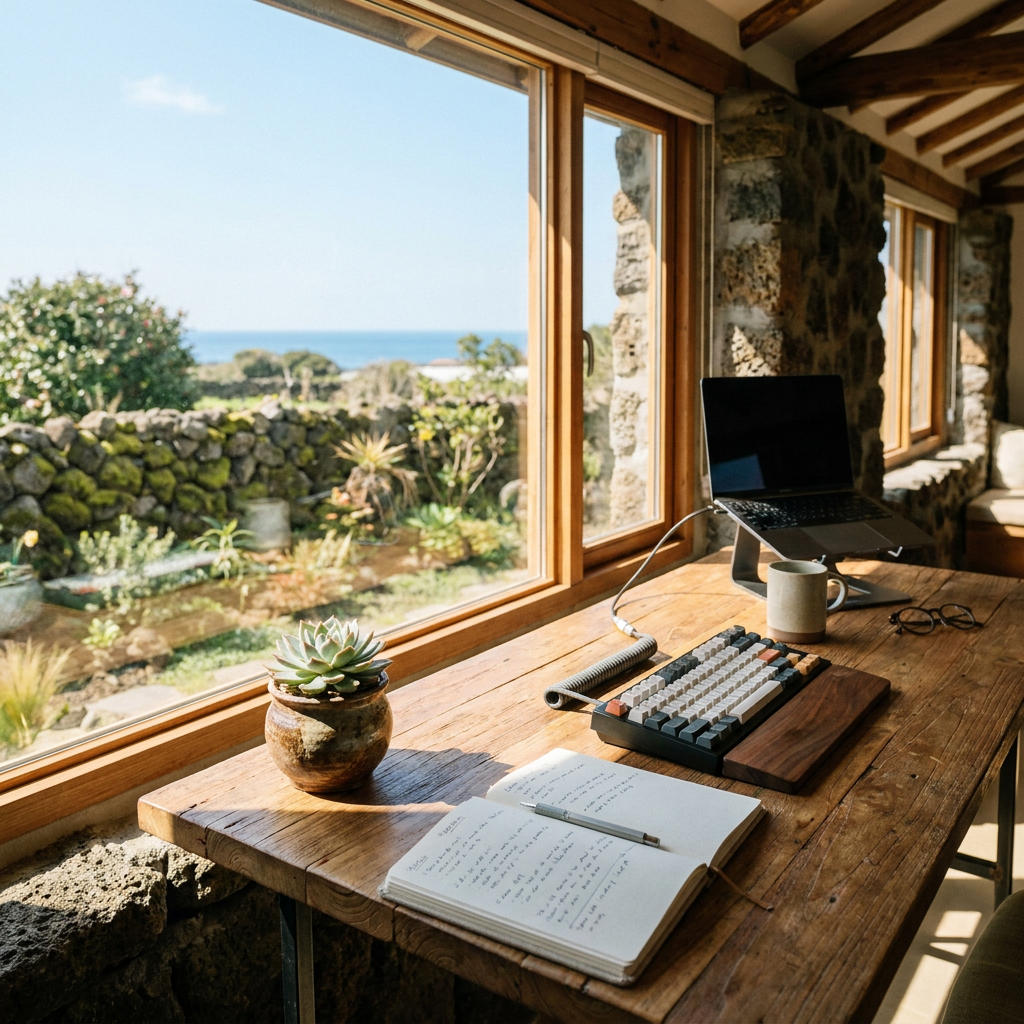
A laptop by the window, basalt rocks outside, and a blue strip of ocean beyond the glass can make work feel lighter before the first email even opens. The trouble starts when the view is perfect but the chair hurts, the call booth is missing, and the nearest decent meal takes twenty minutes by taxi. Jeju Island looks like an easy remote work dream from a travel photo, yet a productive workation needs a desk plan as much as a beach plan. The official Jeju Workation site reported that annual workation participants passed 100,360 as of December 28, 2025, so this is no longer a tiny niche for a few laptop travelers.
Working from coworking spaces in Jeju Island works best when the day is built around energy, Wi-Fi, transport, and recovery. Honestly, the ocean view is a bonus, not the foundation. Jeju’s public workation program now points visitors toward Island Work Lab locations in Jeju City, Seogwipo, and Hamdeok, while private coliving and coworking operators add more flexible choices. One good workspace can save three hours of cafe-hopping stress in a single day, and that changes the whole trip.
Can a sea view really make work easier
The first thing people imagine is the window. A Jeju coworking space with a view feels different from a normal office because your eyes have somewhere soft to land between tasks. Still, a pretty room does not automatically create a good workday. If the internet drops during a client call, that turquoise water suddenly feels useless.
Jeju’s appeal comes from contrast. You can spend the morning in a structured workspace, then step outside into wind, stone walls, local markets, or a coastal road. That switch is powerful because it makes the day feel less trapped. Well, it can also make procrastination dangerously easy.
The official Jeju Workation platform describes the island as a place where office access, accommodation, and local experiences can be connected. That matters because remote work is not just about finding a chair. It is about reducing friction from the moment you wake up until the moment you close the laptop. A smooth path from bed to desk can matter more than a dramatic sunset.
A sea-view workspace helps most when your work involves long focus blocks. After ninety minutes of writing, coding, designing, or planning, looking at open space can reset your attention. I was surprised by how much a five-minute window break helped compared with scrolling on my phone. The view did not do the work for me, but it kept me from burning out too early.
The danger is treating Jeju like a reward before the work is done. You open the laptop at 9 a.m., check one message, look outside, and decide that a short walk will help. Then the short walk becomes coffee, photos, lunch, and a delayed afternoon. Has that ever happened on a remote work trip?
A good Jeju coworking day needs boundaries. I like to make the morning boring on purpose: same seat, same drink, same task list, same deadline. The fun part comes after the hardest block is finished. That order keeps the island from swallowing the workday whole.
Jeju Tourism Organization and Visit Korea both present Jeju as a major travel destination with beaches, volcanic scenery, and strong visitor infrastructure. That popularity is useful because remote workers need more than nature; they need buses, taxis, cafes, pharmacies, food, and clear directions. But high tourism demand can mean crowded roads and expensive stays during peak periods. So the view should be chosen with the calendar in mind.
A desk day in Jeju also has a psychological edge. Being away from the usual home distractions makes it easier to reset habits. The simple act of commuting to a coworking space can create a professional mood. It sounds small, yet the brain loves signals.
A month of random cafe work can cost more than expected. If each cafe stop is 7,000 won and you move twice a day, that is 14,000 won daily before lunch. Over ten workdays, 140,000 won disappears without giving you a guaranteed seat, monitor, or quiet call corner. A paid coworking pass can feel expensive at first, then strangely sensible.
The best mindset is simple. Pick the workspace for work, then pick the view for recovery. When those two overlap, amazing. When they do not, protect the work first and let Jeju reward you afterward.
A good view should not ruin your deadline
Check the official workation options before booking
Start with Jeju’s official workation portal
Public hubs, private partners, and reservation details are easier to compare from the official site.
Open Jeju WorkationWhich Jeju area fits your workday best
Jeju Island looks compact on a map until you start moving between meetings, beaches, cafes, and hotels. The island is Korea’s largest island, and the travel time between regions can shape your whole workation. Staying in the wrong area does not ruin the trip, but it quietly drains energy. That drain shows up at 4 p.m. when you still have two calls left.
Jeju City is the practical choice for short stays. It is close to the airport, has more food options, and works well when your schedule includes frequent calls or tight travel windows. If you arrive at noon and need to work by 2 p.m., Jeju City feels forgiving. The trade-off is that it can feel less like an island escape and more like a regular city with better air.
Seogwipo suits people who want calmer evenings and easier access to southern scenery. The official Invest Korea Jeju office introduced Seogwipo Innovation City as part of Jeju’s public workation office push in 2024. That kind of location can work for longer stays because the mood is less rushed. The downside is that airport transfers and north-side meetings take more planning.
Hamdeok became more interesting after the public Island Work Lab Hamdeok opened on November 28, 2025, according to the Jeju ASEAN Hall announcement. Hamdeok is attractive because the beach is close and the workation identity is now more visible. The area can be brilliant for people who want a morning desk and an evening walk by clear water. It can also be distracting if beach energy pulls you away from deep work.
Area choice by work style
| Area | Best for | Watch out for |
|---|---|---|
| Jeju City | Airport access, short stays, busy call days | Less vacation mood |
| Seogwipo | Longer stays, calmer evenings, southern trips | Longer airport transfer |
| Hamdeok | Beach access, balanced work and rest | High distraction risk |
| Aewol and west coast | Cafe culture, sunsets, slower trips | Transport gaps without a car |
The best area depends on your work calendar, not your Instagram mood. If you have three video meetings every day, choose reliable access over remote beauty. If your work is mostly writing or design, a quieter coastal area can help. If your team expects fast responses, stay closer to transport and food.
Transport is the hidden boss of Jeju workation planning. Buses exist, taxis are available in many areas, and rental cars give flexibility, but each option has trade-offs. A rental car can be convenient for exploring after work, yet parking and fatigue become part of the day. Without a car, your workspace and accommodation should be close enough to walk or taxi cheaply.
The location rule I trust is the fifteen-minute rule. Keep your bed, desk, breakfast, and simple dinner inside a fifteen-minute zone. If one taxi ride costs 12,000 won and you need two rides daily, that is 24,000 won a day. For seven workdays, 168,000 won goes into movement instead of a better room or a better workspace.
Season changes the answer too. Summer brings beach energy, family travelers, higher accommodation demand, and heat. Winter can be calmer, with dramatic wind and quieter workdays. Spring and autumn feel easier for walking, though prices still jump around holidays.
Some remote workers choose one base and explore slowly. Others split the trip between Jeju City and Seogwipo. Splitting can be fun if you stay at least a week, but it eats time if the trip is only three nights. Honestly, changing accommodation on a workday feels romantic only until you are dragging luggage before a call.
The right Jeju base should reduce decisions. You should not need to wonder where to print, where to eat, where to sit, or how to get back after dark. The island is beautiful enough without adding logistical drama. Pick the boringly practical area first, then let the scenery decorate it.
Public hubs and private spaces feel different
Jeju coworking spaces are not all trying to solve the same problem. Public workation hubs tend to focus on structured access, regional policy, and reliable work infrastructure. Private spaces often lean into coliving, community, design, and longer lifestyle stays. Both can be excellent, but they feel different from the moment you walk in.
The official Jeju Workation site lists public workation options under Island Work Lab, including Jeju, Seogwipo, and Hamdeok. That public network matters for companies because it gives the trip a more formal frame. Managers like predictable facilities, clear booking paths, and recognizable public support. Freelancers may like the same predictability for different reasons.
Private coworking and coliving spaces can feel warmer and more social. Some programs introduce meals, community events, local tours, or small-group networking. Hoppin’s 2025 Jeju programs, for example, described coliving and coworking with dedicated work areas and a small remote professional community. That model suits people who do not want to land alone and figure everything out from scratch.
The real question is whether you need a desk or a system. A desk is enough when your trip is short and your work is simple. A system is better when you need housing, coworking, community, and a weekly rhythm. The wrong choice feels expensive even when the price is low.
Public hub versus private coworking
| Type | Strong point | Better for |
|---|---|---|
| Public workation hub | Formal booking, work-first setup | Teams and focused workers |
| Private coworking space | Flexible mood and design | Freelancers and solo workers |
| Coliving coworking | Room and desk in one rhythm | Longer stays and newcomers |
| Cafe work | Low commitment and many views | Light tasks only |
Before booking, check five basics. Look for opening hours, reserved seat rules, meeting room access, phone-call policy, and nearby food. A space can be beautiful and still fail your day if it closes at 6 p.m. when your overseas call starts at 7 p.m. That tiny mismatch can turn into a huge headache.
Internet quality is essential, yet it is not the only tech detail. Power outlets, monitor availability, desk depth, lighting, and room acoustics matter during long work blocks. I have had days where the Wi-Fi was fine but the echo in the room made every call tiring. The shock was realizing that silence can be more valuable than speed.
Community is another divider. Some people do better when a space has other remote workers, casual chats, and after-work dinners. Others need privacy and feel drained by social energy. Neither is wrong. The space should match your work personality, not someone else’s travel fantasy.
💡
Email or message the space before arrival and ask about call rooms, seat reservation, and late access. A two-minute question can prevent a full day of awkward whispering during meetings.
Companies should look at security as well. Shared Wi-Fi, open desks, visible screens, and casual conversations can expose sensitive work. A privacy screen, VPN, and headphones are basic travel tools, not overkill. Well, the beach may be relaxed, but your client data is not on vacation.
A public hub can feel calmer for official workdays, while a private coliving space can feel easier for a longer personal reset. I would choose public for a three-day company workation with meetings. I would choose private coliving for a two-week solo creative sprint. The best Jeju coworking space is the one that removes the most friction from your actual calendar.
Do not book by photos alone
Match the space to your meeting schedule first
Compare official public workation hubs
Island Work Lab pages help you check public hub locations and reservation flow.
Compare Workation HubsA workday rhythm that actually holds up
A successful Jeju coworking day starts before you reach the desk. The night before, decide the workspace, route, breakfast, and first task. This sounds too plain for an island trip. Yet the plain decisions protect the beautiful parts.
My preferred rhythm is deep work before scenery. From 9 a.m. to 11 a.m., I handle the task that would make the day feel successful even if everything else slips. From 11 a.m. to noon, I answer messages and schedule calls. After lunch, I use the lower-energy hours for admin, editing, or lighter collaboration.
Jeju rewards people who close work cleanly. If you let tasks leak into dinner, the island becomes background wallpaper instead of a restorative place. Set a clear shutdown ritual: upload files, send status notes, write tomorrow’s top three tasks, close the laptop. It takes ten minutes and saves the evening.
The official Jeju Workation model emphasizes work plus local life, and that only works when both sides get protected time. A walk to the coast after a finished deadline feels different from a walk taken to avoid a hard task. One gives energy back. The other creates guilt.
Sample Jeju coworking day
| Time | Best use | Small rule |
|---|---|---|
| 8:00-9:00 | Breakfast and commute | No random detours |
| 9:00-11:00 | Deep work | One hard task only |
| 13:00-16:00 | Calls and collaboration | Book call space early |
| 17:30-19:00 | Walk, dinner, recovery | Laptop stays closed |
Food timing matters more than people expect. A heavy lunch followed by a warm room can flatten the afternoon. Jeju has wonderful food, but not every meal belongs before a presentation. Save slow meals for after the last call.
Video meetings need their own plan. Test the background, microphone, and lighting before the first call. If the room is shared, ask whether calls are allowed at the desk or only in booths. Nothing feels more awkward than realizing everyone can hear your quarterly review.
The time-zone issue depends on your team. People working with Korea-based teams can keep a normal day. People working with Europe or North America may need evening calls. In that case, choose accommodation with a desk because the coworking space may not stay open late enough.
A small equipment kit helps. Bring a laptop stand, light keyboard, noise-canceling earbuds, HDMI adapter, and a compact power strip. Buying missing items on the island is possible, but it costs time. If a forgotten adapter costs 25,000 won and a taxi to fetch it costs 15,000 won, that tiny mistake becomes a 40,000 won lesson.
💡
Keep one offline task ready for unstable moments. Editing notes, outlining slides, cleaning a spreadsheet, or reviewing a brief can rescue a work block when Wi-Fi or weather interrupts the original plan.
Weather deserves respect in Jeju. Wind can be strong, rain can change plans, and outdoor movement can take longer than expected. A coworking space near your accommodation protects the schedule when the weather turns. The island feels relaxed, but the weather does not ask for your permission.
The best routine has one reward built in. A sunset walk, a local bakery, a quiet beach bench, or a short drive to a viewpoint can become the day’s finish line. Work first, reward second. That order makes the reward cleaner.
Remote work in Jeju should not copy your normal office day exactly. The point is to keep the professional backbone and change the recovery environment. If you protect the first work block and the shutdown ritual, the middle can flex. That is where Jeju starts to feel worth it.
Your best Jeju memory starts with a finished task
Plan tomorrow’s first work block tonight
Use official Jeju travel information
Routes, attractions, and local travel ideas are easier to check through Jeju’s official tourism channel.
Open Visit JejuWhat the real cost looks like after flights and stays
Jeju coworking costs are not just desk fees. The real budget includes flights, accommodation, local transport, food, workspace access, laundry, coffee, and backup expenses. People often calculate the romantic version first. Then the card statement tells the practical version.
Accommodation is usually the biggest swing factor. A simple room near a workspace can beat a beautiful remote stay when you are working full days. If the remote stay saves 30,000 won per night but adds 25,000 won in daily taxi costs, the math gets weak quickly. For a five-night trip, that difference can vanish before the second meeting day.
Jeju’s workation support has changed over time, so current benefits should be checked before booking. A Chosun English report in March 2026 described a Jeju accommodation support project of up to 300,000 won connected to private workation partners and minimum stay conditions. That kind of program can be useful, but dates, eligibility, and partners matter. Always check the official Jeju Workation portal rather than assuming support applies to your trip.
Flights change with season, day of week, and booking timing. Weekends and holidays can climb fast because Jeju is a major domestic destination. A cheaper flight that lands late at night may still cost more if it forces an extra taxi or a tired first workday. Price is not only the fare; it is the energy attached to the fare.
Rough budget check for a 5-night workation
| Item | Lean estimate | Comfort estimate |
|---|---|---|
| Accommodation | 300,000 won | 650,000 won |
| Workspace and coffee | 80,000 won | 180,000 won |
| Local transport | 60,000 won | 250,000 won |
| Meals | 150,000 won | 350,000 won |
The lean estimate works only when the lodging is close to the workspace and meals are simple. The comfort estimate fits people who want private rooms, taxis, better dinners, and fewer decisions. Neither is wrong. The mistake is planning like a lean traveler and behaving like a comfort traveler.
Food is a quiet budget leak. Jeju meals can be wonderful, and seafood or specialty restaurants can raise the daily average. If lunch is 15,000 won and dinner is 25,000 won, that is 40,000 won daily before coffee. Over five days, meals alone reach 200,000 won without trying hard.
Workspace pricing should be compared against productivity, not only seat cost. A 20,000 won day pass that lets you finish a paid project is cheap. A free cafe seat where you avoid calls and miss deadlines is expensive. This is the kind of math that travel budgets often ignore.
⚠️
Do not assume every coworking space allows long video calls, outside food, late access, or walk-in seating. Rules can change by season and operator, so confirm directly before you build your work calendar around one space.
Laundry and downtime also cost money. A long workation needs clean clothes, quiet recovery, and probably one bad-weather day. Budgeting every hour like a perfect traveler creates pressure. Leave a small buffer so one rainy afternoon does not feel like a failure.
Companies planning a team workation should calculate lost friction too. If ten employees each lose one hour daily because the workspace is far from the stay, that is ten work hours gone per day. Paying more for a better location can be cheaper than losing focus across a team. It is not glamorous, but it is real.
The most useful budget line is a convenience fund. Set aside money for taxis, adapter purchases, delivery meals, or emergency workspace changes. Even 100,000 won can protect the trip from small problems. Jeju is easier when every decision is not a financial debate.
The cheapest stay is not always the cheapest workday
Calculate transport and focus before you book
Check Jeju policy and support news
Official provincial updates help you confirm current workation programs and local notices.
Open Jeju ProvinceWhat I got wrong when I chased the view first
My first Jeju coworking mistake was painfully simple. I chose the prettiest place before checking my actual schedule. The room had a lovely view, the coffee was good, and the morning light looked unreal. Then I discovered that my main call would overlap with the busiest cafe hour.
I remember sitting there with headphones pressed tight, trying to sound calm while cups clattered behind me. My face felt hot, my notes looked messy, and I kept apologizing for background noise. It was not a disaster, but it felt embarrassing. The worst part was knowing I had created the problem by choosing atmosphere over function.
After that, I changed the order. Call days became coworking days, and cafe days became light-task days. If I had a presentation, I booked a proper workspace or stayed somewhere with a desk. If I only had writing and email, a scenic cafe could be enough.
The second mistake was underestimating distance. On the map, everything seemed close enough. In real life, wind, parking, road curves, and waiting for transport changed the day. A thirty-minute move before work can feel fine, but a thirty-minute move between meetings feels like a trap.
The third mistake was packing like a tourist instead of a worker. I had casual clothes, sunscreen, and a camera ready. I did not have the right adapter, a laptop stand, or a backup call location. Amazing, right?
Personal field note
The trip became better when I stopped trying to make every hour scenic. I gave the best focus hours to a plain desk, then gave the evening to Jeju. That felt less glamorous at first, but my stress dropped quickly and the view became a reward instead of a distraction.
There is a practical checklist I now use. Can I take a call without bothering people? Can I reach food in ten minutes? Can I work if it rains? Can I return after dark without stress? If one answer is no, I need a backup plan.
The social side needs balance too. Workation programs and coliving spaces can be great for meeting people, especially for solo remote workers. Yet every dinner invitation takes energy. If you are introverted or on deadline, protect two quiet evenings per week.
Jeju can make you feel like you should be exploring constantly. That pressure is strange because it comes from beauty, not obligation. But productivity improves when you stop trying to consume the whole island. One beach walk after solid work can feel better than five rushed stops.
A coworking trip is successful when you return with completed work and a rested mind. If you return with photos but missed deadlines, the trip was travel with a laptop, not a workation. That distinction matters. It protects your future freedom to work from places like Jeju again.
The view still matters to me. I just do not let it lead the planning anymore. Function picks the base, rhythm protects the day, and scenery fills the gaps. That is when Office with a View finally starts to work.
Make the view your reward, not your workflow
Build one backup plan before your first call
Review Korea travel basics before arrival
Official tourism information helps with transport, destinations, and practical island planning.
Open Visit KoreaFrequently Asked Questions
Q1. Is Jeju Island good for remote work?
A1. Jeju Island can be very good for remote work when you choose the workspace around your meeting schedule. The island has official workation hubs, private coworking options, strong tourism infrastructure, and plenty of recovery spaces after work.
Q2. Which area is best for a first Jeju workation?
A2. Jeju City is usually the easiest first base because it is close to the airport and has many daily conveniences. Seogwipo and Hamdeok can feel more relaxed if your schedule allows longer transfers.
Q3. Are public workation hubs better than private coworking spaces?
A3. Public workation hubs are often better for structured workdays and company use. Private coworking or coliving spaces may be better for freelancers, solo workers, and longer stays that need community.
Q4. Can I work from cafes in Jeju instead?
A4. Cafe work is fine for light tasks, writing, reading, and short email sessions. For video calls, confidential work, or full-day focus, a coworking space is usually safer and more comfortable.
Q5. Do I need a rental car for a Jeju coworking trip?
A5. A rental car is helpful but not always necessary. If your accommodation, workspace, meals, and transport stops are close together, you can manage with walking, buses, and taxis.
Q6. How many days should I stay for a workation in Jeju?
A6. Three nights works for a short reset, while five to seven nights gives you enough time to settle into a real rhythm. For deep work or creative projects, two weeks can feel much better than a rushed long weekend.
Q7. What should I check before booking a coworking space?
A7. Check opening hours, call room rules, seat reservations, Wi-Fi, outlets, food access, and distance from your stay. These details matter more than photos when you have real deadlines.
Q8. Is Jeju workation expensive?
A8. Jeju workation can be affordable or expensive depending on flights, season, accommodation, transport, and workspace choice. The biggest hidden costs are usually taxis, meals, and choosing lodging too far from the workspace.
Q9. Is Hamdeok good for working with a sea view?
A9. Hamdeok can be a strong choice for workers who want beach access and a more scenic daily rhythm. Since Island Work Lab Hamdeok opened in late 2025, it has become more relevant for public workation planning.
Q10. What is the biggest mistake on a Jeju coworking trip?
A10. The biggest mistake is choosing the view before checking the work setup. A beautiful space without quiet calls, stable seating, or easy transport can turn a dream workation into a stressful one.