📋 Table of Contents
- The first night at the recycling station felt like a test
- The rules looked strict, but they had a rhythm
- The categories started making sense after one mistake
- Food waste was the part that surprised me most
- Neighbors taught me without saying much
- The checklist that saved me from embarrassment
- Frequently Asked Questions
The elevator opened to the basement level, and I walked out holding three bags like someone carrying evidence. One bag had plastic, one had paper, and the third was full of things I no longer trusted myself to identify. In many Korean apartments, recycling is not a casual toss into one blue bin; it is a small weekly ritual shaped by labels, timing, washing, and community pressure. South Korea’s Ministry of Environment launched a household waste separation website in 2025 that explains disposal methods for 730 everyday waste items, which says a lot about how detailed the culture has become.
At first, I thought recycling in Korea was only about being eco-friendly. Then I realized it was also about apartment life, shared space, quiet discipline, and not being the person whose greasy takeout container ruins a whole bin. The system did not feel glamorous, yet it felt oddly precise, like a neighborhood habit built over years. Honestly, I was nervous enough to stand there pretending to read labels while secretly watching what everyone else did.
The first night at the recycling station felt like a test
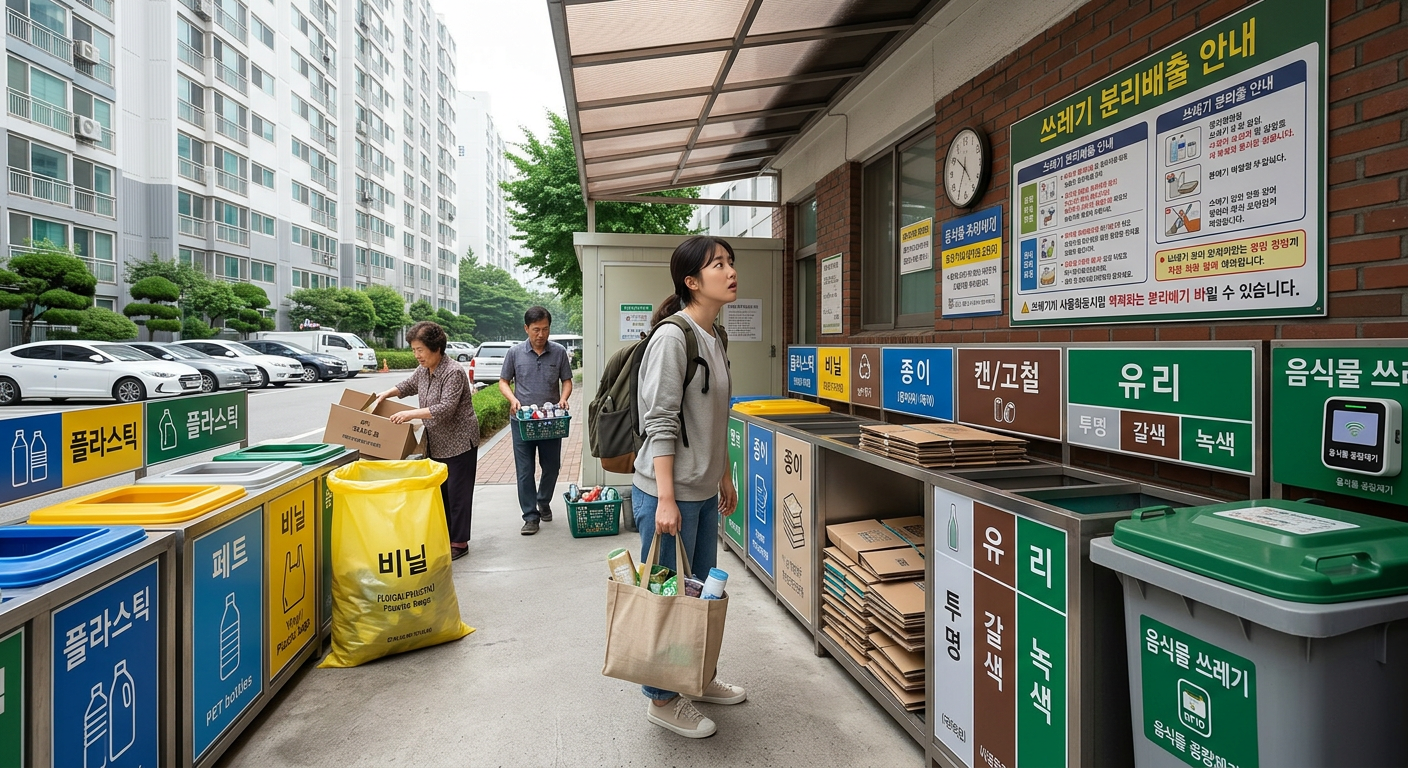
The recycling area in my apartment was not hidden, but it still felt like entering a room with unwritten rules. There were bins for paper, plastic, vinyl, cans, glass bottles, styrofoam, clear PET bottles, and sometimes separate spaces for batteries or small electronics. Nothing looked difficult from far away. Up close, every object suddenly became suspicious.
A yogurt cup looked like plastic, but the foil lid was different. A delivery box looked like paper, but the tape and invoice sticker had to come off. A coffee cup looked recyclable until the inside smelled like old latte. Small things mattered.
The first lesson was simple: empty, rinse, remove, separate. Many local Korean waste guides repeat this same logic in slightly different words, especially for plastic containers, cans, and bottles. Gimje City’s English guide, for example, tells residents to remove contents, rinse containers, and separate labels or attached parts before disposal.
That sounds easy until you are holding a sauce-stained delivery container at 10 p.m. and wondering whether one stubborn red pepper paste mark makes you a bad citizen. I had one of those moments. The container was not clean enough, the paper label was half torn, and I could feel an older neighbor nearby sorting bottles with terrifying confidence. I panicked a little.
What shocked me was how quiet the whole scene was. Nobody lectured me. Nobody pointed. People just sorted, folded, rinsed, and left. That silence somehow made the rule feel stronger than a sign.
In many countries, recycling feels optional or symbolic. In a Korean apartment, it can feel like part of the building’s operating system. The habit is supported by national waste policies, local rules, apartment notices, and the simple fact that everyone can see the bins. When the system is this visible, your small mistake feels bigger.
I started to understand why residents often keep multiple small bags at home. One for paper, one for plastic, one for vinyl, one for glass or cans, and sometimes a separate place for clear PET bottles. It is not because people enjoy clutter. It is because sorting at the source saves embarrassment downstairs.
The cost angle is real too. Korea has long used volume-based waste bags for general trash, so throwing everything into regular garbage can literally cost more over time. A 20-liter paid garbage bag may look cheap one by one, but 1 bag a week becomes 52 bags a year. When recycling is done properly, the regular trash bag fills more slowly.
That first night taught me that Korean recycling is less about perfection and more about preparation. If I rinsed containers right after eating, flattened boxes before they piled up, and removed labels before going downstairs, everything became easier. If I waited until the trash bag smelled strange, the whole process felt like punishment. Have you ever learned a rule only after standing in front of strangers with the wrong bag?
The adventure began with confusion, but the rhythm came faster than expected. The bins did not change. My habits did. After a week, I was not fluent, but I no longer looked like a tourist in my own basement.
What I noticed on the first recycling night
| Item | What I first thought | What I learned |
|---|---|---|
| Delivery box | Just paper | Tape and invoice should come off |
| Plastic cup | Always recyclable | It needs to be emptied and rinsed |
| Clear bottle | Regular plastic | Often separated as clear PET |
| Food-stained paper | Paper bin | Contamination can make it general waste |
One wrong bag can make the basement feel like a stage
Check the official sorting guide before your first recycling night
Korea now has a dedicated household waste separation site
The Ministry of Environment announced a website explaining disposal methods for 730 common household waste items.
Check separation rulesThe rules looked strict, but they had a rhythm
Korean apartment recycling can look strict because the categories are visible and specific. Yet after a few rounds, the logic becomes surprisingly practical. Recyclables need to be clean enough to process, separated enough to avoid contamination, and placed in the correct spot so collection workers do not have to fix every household’s mistake. It is discipline, but it is also logistics.
Paper is not just paper when it is coated with oil. Plastic is not just plastic when food is still inside. Glass bottles are not the same as broken ceramic plates. This is where beginners get trapped.
The Ministry of Environment’s English site describes waste policy as a system that helps people practice proper separation through user-friendly guides and apps. That wording feels official, but the apartment version is very real: signs near bins, notices in elevators, management office reminders, and sometimes a security guard who knows every rule by memory. :contentReference[oaicite:2]{index=2}
The rhythm usually starts at home. Wash the container before it dries. Peel the label before the bottle pile grows. Fold the box before the hallway becomes a cardboard mountain. Put vinyl packaging into a separate bag so it does not blow around.
Honestly, the biggest change was mental. I stopped asking, “Can this be recycled?” and started asking, “Can this be processed if I throw it away like this?” That one shift made the rules feel less petty. It turned recycling from a moral exam into a practical handoff.
Clear PET bottles are a good example. In many apartment systems, transparent water and beverage bottles are separated from other plastics because they can become higher-quality recycled material when kept clean and separate. The Korea Environment Corporation explains the separate discharge mark system as a way to make packaging easier to separate and recycle. :contentReference[oaicite:3]{index=3}
The same logic applies to labels and caps. A clear bottle with a label still wrapped around it is less clean as a material stream. A bottle that has been emptied, rinsed, crushed, and separated becomes easier to handle. It is not glamorous, but it works.
Apartment timing also matters. Some buildings allow recycling every day, while others set specific days or hours. Villas and detached houses may follow district schedules instead of apartment-style collection rooms. So a rule that works in one neighborhood may not match another building exactly.
That local variation is why I learned to photograph the notice board. It sounds silly, but one photo saved me from carrying styrofoam down on the wrong day. A mistake like that costs only five minutes, yet it feels strangely dramatic when you have to ride the elevator back up with your trash. Small humiliation travels fast in a quiet elevator.
Once I followed the rhythm, the strictness softened. Empty first, rinse lightly, separate materials, check labels, follow the building schedule. Five steps. Not effortless, but not impossible.
💡 Small trick
Keep a small “uncertain items” box near your recycling area at home. When you are not sure about a lid, coated pouch, pump bottle, or stained paper, do not guess while rushing. Check the apartment notice or official separation website once, then decide. This habit saved me from repeating the same mistake three times.
The categories started making sense after one mistake
My first real mistake involved a pizza box. I folded it beautifully, felt proud, and carried it to the paper section. Then I noticed the oil stains. Suddenly the box looked less like paper and more like evidence of poor judgment.
That was when I understood contamination. Recycling is not just about the material name; it is about the condition of the material. Clean paper can be recycled, but greasy paper can damage the quality of the batch. A plastic container is not helpful when half the sauce is still inside.
The official logic is consistent across many guides: remove contents, rinse when needed, remove attached materials where practical, and separate by material type. Gimje City’s guide gives these steps for plastic, vinyl, and styrofoam disposal, including removing labels or attached materials where possible. :contentReference[oaicite:4]{index=4}
Paper was the category I underestimated. Newspapers, books, boxes, and clean paper packaging usually feel obvious. Receipts, coated paper, wet paper, and food-stained paper are less obvious. One oily box taught me more than any poster.
Plastic looked easy too, until I met mixed-material packaging. A pump bottle may have a plastic body, a metal spring inside the pump, and a label stuck to the outside. Some local guides specifically advise removing pump parts from bottles when the internal spring is attached. That level of detail surprised me.
Vinyl packaging was another adjustment. Snack bags, plastic wrappers, and thin packaging do not always belong with hard plastic containers. Many apartments have a separate vinyl section, and the bag should be clean enough and contained so it does not fly around. Windy vinyl is chaos.
Glass bottles made more sense after I separated them from ceramics. A soju bottle and a broken mug are not the same recycling story. Heat-resistant glass, mirrors, ceramics, and light bulbs may need different handling depending on the local rule. It feels annoying until you imagine what happens at a sorting facility.
Cans were fairly simple: empty and rinse. The tricky part was aerosol cans, because they need to be emptied safely. Batteries and small electronics had separate collection points in some buildings. I learned not to improvise with those.
The more I sorted, the more I noticed packaging design. A bottle with an easy-peel label made me strangely grateful. A container with glued-on layers made me sigh. Good design turns a resident into a better recycler without a lecture.
After the pizza box incident, I started sorting at the kitchen counter instead of at the apartment bin. That one change saved time. It also saved face. Have you ever pretended to know what you were doing while secretly copying a neighbor’s hands?
Common apartment recycling categories
| Category | Usually accepted condition | Common mistake |
|---|---|---|
| Paper | Clean, dry, flattened | Food-stained boxes |
| Plastic | Empty, rinsed, separated | Leaving sauce inside |
| Vinyl | Clean and bagged | Mixing dirty wrappers |
| Clear PET | Label removed, bottle crushed | Throwing with mixed plastic |
| Glass and cans | Empty and rinsed | Mixing ceramics or unsafe items |
The material matters, but the condition matters more
Clean it before it becomes tomorrow’s problem
Packaging marks are not decoration
The Korea Environment Corporation explains Korea’s separate discharge mark system for recyclable packaging.
Learn discharge marksFood waste was the part that surprised me most
Food waste in a Korean apartment felt like a separate world. In some buildings, residents use RFID food waste bins that weigh the waste and charge households through management fees. In other places, prepaid food waste bags or local systems are used. Either way, food waste is not treated like ordinary trash.
The biggest surprise was water. Wet food waste weighs more, smells worse, and costs more where weight-based systems are used. Residents often drain soup, squeeze moisture from vegetable scraps, and avoid throwing liquid into the bin. Suddenly, a strainer became an environmental tool.
Recent reporting on South Korea’s food waste system noted a 96.8% food waste recycling rate in 2023 and described RFID bins that charge households by weight in many apartment complexes. The same report said Seoul food waste dropped from 3,181 tons a day to 2,419 tons a day over a decade after citywide implementation began in 2013.
Those numbers made the small kitchen habits feel less silly. Draining kimchi soup before disposal is not just about saving a few won. It reduces weight, odor, and processing burden. A tiny habit repeats across thousands of households.
Still, food waste rules can confuse newcomers. Bones, shells, tea bags, coffee grounds, fruit pits, and thick peels may not be accepted as food waste in many local systems because they are difficult to process into feed, compost, or energy. Local rules matter. Guessing is risky.
I learned the hard way with onion skins. I assumed anything from food preparation belonged in food waste. Then I found out that some items are treated differently depending on local disposal standards. The feeling was ridiculous: how could an onion peel make me question my entire life?
The RFID bin itself felt oddly futuristic. Tap the card, open the lid, pour in the drained scraps, close it, and the machine records the weight. It is not dramatic. That is the genius of it.
When cost becomes visible, behavior changes. If 1 kilogram costs only a small amount, it may not sound like much. Yet watching the weight appear makes you think twice about buying too much, leaving side dishes untouched, or tossing watery leftovers. Feedback is powerful.
Apartment food waste also changed how I cooked. I bought smaller portions, stored vegetables better, and stopped making “just in case” side dishes that became trash three days later. A 5,000 won bundle of greens is not expensive, but throwing away half of it every week becomes a quiet bill. The bin taught me budgeting without saying a word.
The part that impressed me most was not the machine. It was the social normality. People did not debate whether food waste should be separated. They just did it. That ordinary acceptance felt like the real secret discipline.
Direct experience
My biggest failure was carrying watery food waste to the RFID bin without draining it well. The smell was awful, the bag felt heavy, and I felt embarrassed before I even reached the machine. After that, I kept a small strainer in the sink and let scraps drain before disposal. It felt like a tiny household upgrade, but the difference was immediate.
Neighbors taught me without saying much
The strongest recycling education in my apartment did not come from a brochure. It came from watching neighbors. An older man flattened boxes with perfect speed. A student removed labels from bottles while checking her phone. A parent handed a child a rinsed can and pointed to the right bin.
Nobody made a speech. That was the point. The building had a shared script, and residents learned by following it. When enough people behave the same way, the rule becomes atmosphere.
Korea’s waste culture is not only about individual virtue. It is built through policy, apartment management, infrastructure, fees, and public expectation. Research published in 2025 notes that mandatory separate discharge dates back to the early 1990s and that the volume-based waste fee system has shaped household disposal habits since the mid-1990s.
That history matters because habits need structure. A person may care about the environment, but convenience decides whether the behavior survives. Korean apartments often make sorting convenient by putting labeled bins in one shared space. That convenience turns intention into routine.
The social side can feel intense for foreigners or first-time residents. You worry about being judged. You worry about misreading Korean labels. You worry about holding up someone behind you while you decide whether a lid is plastic or general waste. I felt all of that.
Then something changed. Once I admitted I did not know everything, I started asking simple questions. “Does this go here?” was enough. Most people answered quickly and kindly. Some even looked relieved that I cared.
The apartment management office became another quiet teacher. Notices near the elevator explained collection days, wrong disposal examples, and changes to local rules. I used to ignore those notices because they looked ordinary. Then I realized they were the building’s survival manual.
There is a subtle pride in doing it correctly. Not loud pride. More like the satisfaction of leaving a clean recycling area behind you. When I finally sorted a week’s worth of recyclables without hesitating, I felt oddly triumphant.
Of course, the system is not perfect. Bins overflow. People make mistakes. Labels are confusing. Some packaging is badly designed. Yet the daily discipline remains visible, and that visibility keeps the habit alive.
The secret was never that Koreans are born knowing how to recycle. The secret is that the environment trains the behavior. Clear bins, repeated rules, paid trash bags, food waste charges, and neighbors doing the same thing all create momentum. Would most of us recycle better if the system made the correct choice this visible?
The apartment teaches you before anyone says a word
Read the notice board like it belongs to your rent
Local rules can differ by district and building
Seoul and district-level guides often list disposal time, place, and category details for residents.
Check Seoul environment noticesThe checklist that saved me from embarrassment
My recycling checklist became short because long systems fail on busy nights. Empty the contents. Rinse if food or drink remains. Remove labels, tape, and mixed parts when possible. Separate by the apartment’s categories.
The second layer is timing. Some apartments have fixed recycling days. Some allow daily access. Some separate large waste pickup from normal recycling. A chair, mattress, or appliance usually needs a different bulky waste process, not a casual trip to the basement.
The third layer is “when in doubt, do not contaminate the bin.” That sounds strict, but it is practical. One greasy item can create problems for a clean material stream. If an item is too dirty to clean, it may belong in general waste depending on local rules.
For clear PET bottles, I use a four-step habit: empty, rinse, remove label, crush. The cap rule may vary by local collection practice, so I follow my apartment’s sign. This sounds small, yet it makes the bottle pile compact and clean. It also feels satisfying.
For paper, I ask whether it is clean and dry. If it is wet, oily, coated, or mixed with plastic, I pause. For boxes, I remove tape and flatten them. Ten seconds at home saves awkward folding beside the bin.
For food waste, I drain water first. I check local rules for shells, bones, pits, tea bags, and coffee grounds because not everything from the kitchen counts as food waste. That detail surprised me more than any plastic rule. Food waste is biological, but the system is industrial.
For vinyl, I keep clean wrappers together in one bag. Dirty vinyl does not magically become recyclable because it is thin. If the wrapper is oily beyond rescue, I check the local rule instead of wishfully tossing it into the vinyl bin. Wishful recycling is still a problem.
For cans and glass, I empty and rinse. For batteries, bulbs, and electronics, I look for dedicated collection boxes. For broken items, I do not assume. Safety matters as much as sorting.
The checklist did more than prevent mistakes. It changed how I shopped. I started choosing packaging that was easier to separate, buying smaller amounts of fresh food, and avoiding products wrapped in three unnecessary layers. Recycling began before disposal.
The adventure ended with a strange kind of respect. Korean apartment recycling can feel intimidating at first, but it teaches an everyday discipline that is physical, social, and environmental at the same time. You wash, peel, fold, drain, and separate. Then one day, without noticing, you become the person someone else watches to learn the rules.
My no-panic recycling checklist
| Step | Action | Why it helps |
|---|---|---|
| 1 | Empty leftovers | Prevents contamination and odor |
| 2 | Rinse lightly | Keeps bins cleaner |
| 3 | Remove labels and tape | Improves material separation |
| 4 | Flatten and crush | Saves shared bin space |
| 5 | Follow building notices | Avoids local-rule mistakes |
⚠️ Caution
Do not rely only on a foreign blog post, including this one, for final disposal decisions. Korean waste rules can differ by city, district, building, and collection contractor. The safest habit is to check your apartment notice board, management office, district website, or the national separation guide. When a category looks uncertain, keeping the recyclable stream clean is better than guessing.
Recycling gets easier when you sort before you leave home
Make a tiny station in your kitchen and avoid basement panic
Start with your own district and apartment rules
Official rules and apartment notices should be treated as the final guide for disposal day.
Visit Ministry waste policy pageFrequently Asked Questions
Q1. Is recycling mandatory in Korean apartments?
A1. Yes, separate disposal is treated as a normal household responsibility in Korea. Apartment buildings usually provide labeled areas for recyclable categories, and residents are expected to follow local and building rules. The exact schedule and categories can vary by building.
Q2. What is the most important rule for beginners?
A2. The most useful beginner rule is empty, rinse, remove, and separate. Empty containers before disposal, rinse food residue when needed, remove labels or attached parts where practical, and place each item in the correct category. This prevents most embarrassing mistakes.
Q3. Do clear plastic bottles go with regular plastic?
A3. Clear PET bottles are often collected separately in Korean apartments. Residents are commonly asked to empty the bottle, remove the label, crush it, and follow the building’s cap rule. Check the sign near your apartment’s recycling area because local practice can differ.
Q4. Can greasy pizza boxes go into paper recycling?
A4. Greasy or food-stained paper usually should not be placed with clean paper recycling. Contamination can lower the quality of the recyclable material. If only part of the box is clean, some residents tear off the clean section and discard the dirty part according to local rules.
Q5. How does food waste disposal work in Korean apartments?
A5. Many Korean apartments use food waste bins, prepaid bags, or RFID systems depending on the area and building. RFID bins can weigh food waste and charge households through management fees. Draining water from food scraps helps reduce smell and weight.
Q6. Are bones and shells considered food waste?
A6. Bones, shells, fruit pits, tea bags, and coffee grounds may not be accepted as food waste in many local systems. These items can be difficult to process into compost, feed, or energy. Always check your local guide before disposal.
Q7. What should foreigners living in Korea do first?
A7. Foreign residents should first photograph the apartment recycling notice and ask the management office about collection days. Then set up small separate bags at home for paper, plastic, vinyl, clear PET, cans, and glass. This reduces confusion at the shared bins.
Q8. What happens if I recycle incorrectly?
A8. Incorrect recycling can lead to apartment warnings, rejected waste, extra management work, or local penalties in some cases. More commonly, it creates inconvenience for neighbors and collection workers. Repeated mistakes are easier to avoid once you learn your building’s categories.
Q9. Can I throw large furniture into the recycling area?
A9. Large furniture usually requires a bulky waste disposal process, not normal recycling. Many districts require a paid sticker, online application, or scheduled pickup. Your apartment management office can tell you the correct local process.
Q10. Why does Korean apartment recycling feel so disciplined?
A10. It feels disciplined because infrastructure, cost systems, building rules, and social habits all work together. Residents see labeled bins, use paid trash systems, follow apartment notices, and watch neighbors sort correctly. Over time, that structure turns recycling into a daily routine.
'Korean Culture' 카테고리의 다른 글
| A Guide to Korean Holidays: Celebrating Tradition and Culture (6) | 2024.09.20 |
|---|
