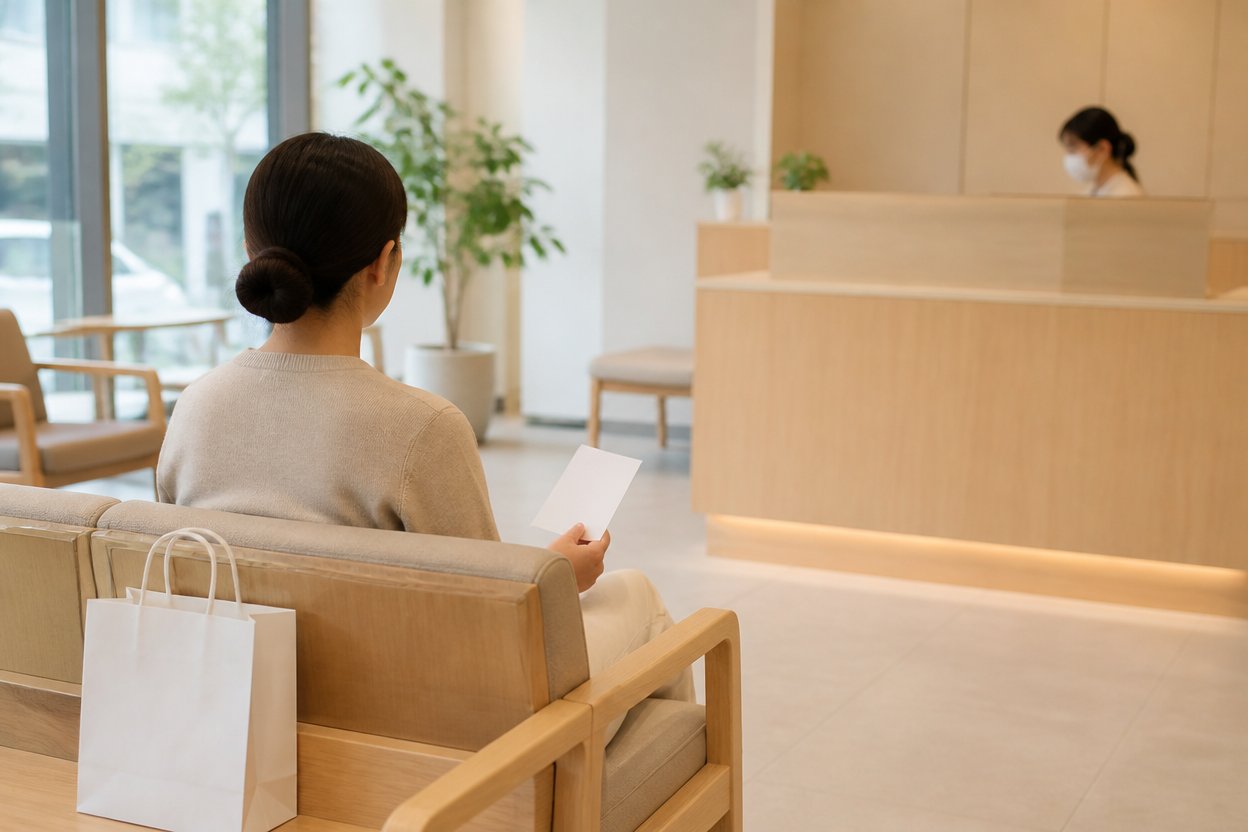
Your first bill at a Korean clinic is usually smaller than you feared, as long as you bring the right card.
With National Health Insurance, you pay only part of the covered cost at a Korean clinic or hospital, about 30 percent at a neighborhood clinic and more at larger hospitals, but since May 20, 2024 you must show a photo ID such as your Residence Card at the desk or the insurance does not apply.
The same split applies at the pharmacy, where the usual share is 30 percent of the covered drug cost.
Our family has used the clinic downstairs for everything from a child's fever to a sprained wrist, and the paperwork is simple once you know the three things the desk will ask.
The rates below are general rules for adults under 65 in city areas, and special rules apply to children, pregnancy, older patients and many conditions, so the hospital's own bill is the final word.
What should I bring to a Korean clinic?
Bring a photo ID with your foreigner registration number.
The Ministry of Health and Welfare made identity checks mandatory for insured care from May 20, 2024.
Accepted IDs include the Residence Card (ARC), a passport, a mobile Residence Card and the official mobile health insurance card app.
If you cannot show ID, the clinic can charge you the full price, so ask at the desk how to settle it if you bring the ID later.
Bring your medicine list and any notes from earlier treatment, in English if that is easier.
A Korean phone number is useful, since clinics often text you when your turn comes or when results are ready.
How does a clinic visit work?
You check in at the front desk and say what is wrong.
The desk confirms your insurance with your ID and registration number.
You wait, see the doctor, and come back to the desk to pay.
If the doctor prescribes medicine, you get a paper prescription and take it to any pharmacy, usually one in the same building.
You do not need an appointment at most neighborhood clinics.
Morning hours are busiest, and many clinics close for lunch and open on Saturday mornings.
Clinics here move fast, a habit MARU explains in its article on ppalli-ppalli culture, so have your symptoms ready in one or two sentences.
How much is the copay at each type of hospital?
Korea sorts medical facilities into levels, and your share rises with the level.
These are outpatient rates for a regular insured adult under 65 in a city area, based on the Health Insurance Review and Assessment Service (HIRA) guide.
| Where you go | Your share of the covered cost | Notes |
| Clinic (uiwon, 의원) | 30% | Neighborhood doctors, most first visits |
| Hospital (byeongwon, 병원) | 40% | Mid-size hospitals |
| General hospital (종합병원) | 50% | Larger hospitals with many departments |
| Tertiary hospital (상급종합병원) | Consultation fee in full plus 60% of the rest | University hospitals, usually with a referral |
| Pharmacy (약국) | 30% of the covered drug cost | Prescriptions from any of the above |
Outside city areas, the hospital and general hospital rates are a little lower.
Hospitals drop amounts under 100 won when they calculate your share.
Can you show me an example?
Here is an example with assumed costs.
You visit a clinic for a cold, and the covered cost of the visit is 20,000 won.
You pay 30 percent, which is 6,000 won.
The pharmacy fills the prescription, and the covered drug cost is 10,000 won.
You pay 30 percent there too, which is 3,000 won.
Your total for the day is 9,000 won, and NHIS pays the rest directly to the clinic and the pharmacy.
Now imagine the same visit at a general hospital.
Your share of the same 20,000 won would be 10,000 won, before any tests.
That is why most people start at a clinic unless the problem is serious.
What is not covered?
Items outside the insurance list, called non-covered items (bigeubyeo, 비급여), are paid in full by the patient.
These include many cosmetic treatments, some tests and certain medicines.
Medical certificates and documents for private insurance are also usually charged as non-covered fees.
Ask before a test if you are unsure whether it is covered, especially at private specialty clinics.
Clinics must post their non-covered prices, so you can also check the price list near the desk or on their website.
Do I need a referral for a university hospital?
For outpatient care at a tertiary hospital, you generally need a referral letter (jinryo uiroeseo, 진료의뢰서) from a clinic or hospital.
Without one, the insurance usually does not apply to that visit, apart from emergencies and some exceptions.
HIRA also lists a 100 percent share for mild conditions treated as outpatients at tertiary hospitals.
So start at a clinic, and let the doctor refer you if you need specialist care.
Which receipts should I ask for?
Ask at the desk before you leave, because reprinting later can take another visit.
| Document | Korean name | When you need it |
| Medical bill receipt | 진료비 계산서·영수증 | Every visit, for your records and most claims |
| Itemized bill | 진료비 세부산정내역 | Private insurance claims, checking charges |
| Pharmacy receipt | 약제비 계산서·영수증 | Claims for prescription costs |
| Medical certificate or diagnosis | 진단서 / 소견서 | Insurance claims, school or work absence, usually a fee |
| Proof of visit | 진료확인서 | Simple proof that you attended |
If you hold travel or private insurance from home, ask your insurer which documents it accepts before you go.
Many larger hospitals can issue English versions, but small clinics may only print Korean.
A clear photo of the Korean receipt plus the itemized bill usually answers an overseas insurer's questions.
What if my health insurance is not active?
Then you pay the full price.
This happens if your enrollment has not started yet, or if NHIS has restricted benefits because premiums are overdue.
Check your status in the NHIS app or at a branch before a planned procedure.
If you paid in full while you were in fact covered, keep every receipt and ask NHIS how to claim the insured share back.
Forms at the desk ask for your birth date, and in Korea age can be counted in more than one way, as MARU explains in its guide to Korean age, so write the date, not the number.
Frequently asked questions
Do I need an appointment at a Korean clinic?
Usually not. Walk in, check in at the desk and wait for your name.
Can I use my passport instead of my Residence Card?
A passport is accepted as ID, but the clinic still needs your foreigner registration number to apply insurance.
How much does a pharmacy charge with NHIS?
The general share is 30 percent of the covered drug cost.
Why did a university hospital charge me so much?
Tertiary hospitals have the highest share, and visits without a referral or for mild conditions can be charged in full.
Can I get an English receipt?
Ask at the desk. Larger hospitals often can, while small clinics may only issue Korean receipts.
Sources: Health Insurance Review and Assessment Service (hira.or.kr), outpatient copay rates under the National Health Insurance Act Enforcement Decree, Annex 2; Ministry of Health and Welfare press release on mandatory identity checks (May 17, 2024); rates and documents differ by patient and facility, so the hospital's bill and NHIS take priority.


