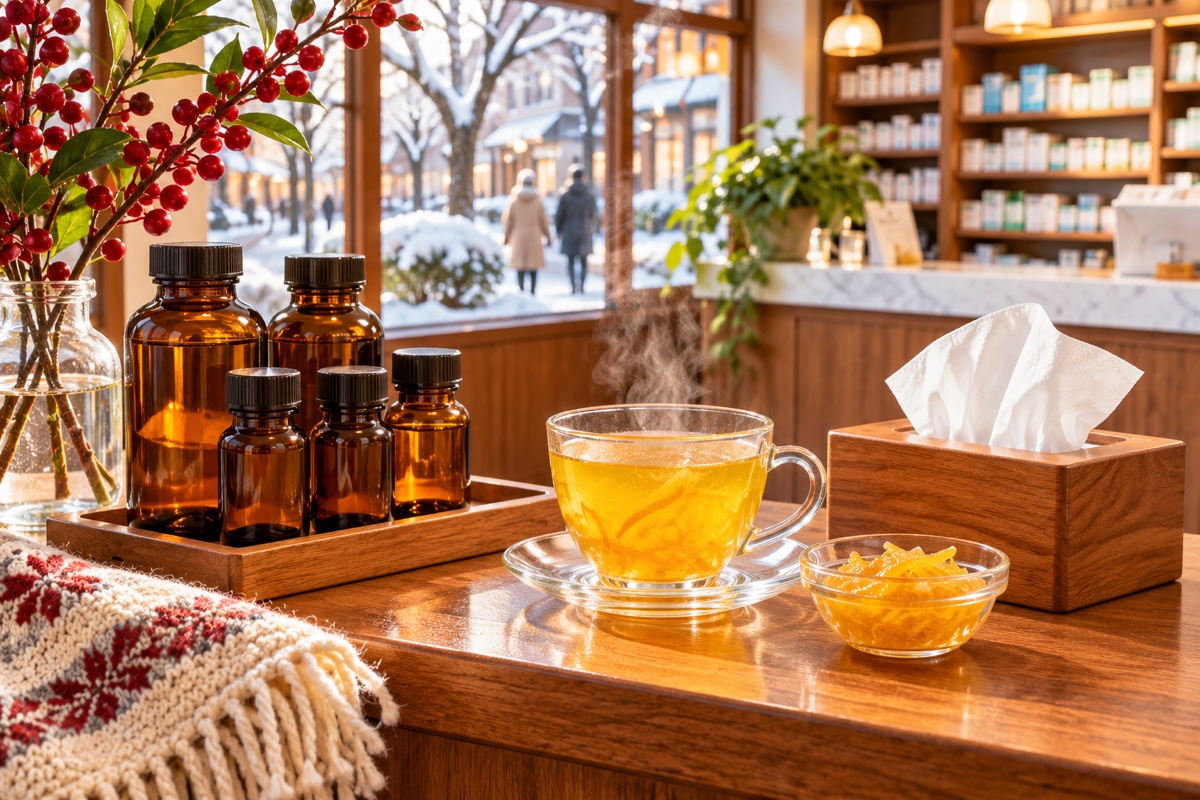
If you catch a cold in Korea, go to a pharmacy, called a yakguk (약국), and describe your symptoms.
Korean pharmacists sell common cold medicines over the counter, such as Pancol A (판콜에이), Panpyrin Q (판피린큐) and Tylenol, and many speak enough English to help if you show your symptoms.
Convenience stores also carry a short list of basic medicines when pharmacies are closed.
We are a family in Seoul and someone in our house has a cold most of the winter, so this is the list we actually use.
This is general information, not medical advice.
If you have a high fever, trouble breathing or a child who seems very unwell, see a doctor.
Where do I buy cold medicine in Korea?
Look for a sign with the Korean character 약 (yak), usually in green or red.
Pharmacies are everywhere in Seoul, especially on the ground floor of buildings with clinics.
Most open in the morning and close in the evening, and some are closed on Sundays.
If you need something late at night, look for a «public night pharmacy» sign or check the map apps.
Convenience stores sell a limited range of safe household medicines around the clock, including some fever reducers, cold remedies, digestives and patches.
What are common Korean cold medicine names?
These are names you will see on Korean pharmacy shelves.
Showing the Korean name on your phone is the fastest way to ask.
| Name (Korean) | Common use | Form |
| Pancol A (판콜에이) | General cold symptoms | Small drinkable bottle |
| Panpyrin Q (판피린큐) | Cold with headache and fever | Small drinkable bottle |
| Tylenol (타이레놀) | Fever and pain | Tablet |
| Fightoven (화이투벤) | Cold with runny nose and cough | Capsule or tablet |
| Theraflu (테라플루) | Cold and flu symptoms | Powder or tablet |
| Strepsils (스트렙실) | Sore throat | Lozenge |
The small brown drinkable bottles are a very Korean thing.
Office workers buy one at the first sniffle and drink it at the counter.
Pharmacists will usually ask a few questions before handing over anything, especially if you mention other medicines or pregnancy.
How do I describe my symptoms to a Korean pharmacist?
Many pharmacists understand basic English words like fever, cough and sore throat.
If not, a translation app works well, or you can show these words.
| English | Korean | How to say it |
| Cold | 감기 | gamgi |
| Fever | 열이 나요 | yeori nayo |
| Sore throat | 목이 아파요 | mogi apayo |
| Cough | 기침 | gichim |
| Runny nose | 콧물 | konmul |
| Headache | 머리가 아파요 | meoriga apayo |
| For a child | 아이용 | aiyong |
Tell the pharmacist the age and weight if the medicine is for a child.
Children's syrups are dosed by age and weight, and Korean pharmacists take that seriously.
Can I buy cold medicine at a Korean convenience store?
Yes, but only a small selection.
Korea allows a limited list of household medicines in convenience stores, which usually includes fever and pain tablets, a cold medicine, digestives and pain patches.
Packs are small and the clerk cannot give advice.
It is fine for a midnight headache.
For anything more, wait for a pharmacy.
When should I see a doctor instead?
In Korea, many medicines that are over the counter in other countries, including antibiotics, need a doctor's prescription.
Pharmacists will send you to a clinic if you ask for them.
Small local clinics are quick, and visits are usually short.
We go to a clinic when a fever lasts more than a couple of days, when a child stops drinking, or when a cough keeps us up at night.
After the clinic, you take the prescription to a pharmacy, usually the one downstairs.
For emergencies, call 119.
For help with interpretation or finding medical services, the Korea Travel Hotline at 1330 runs around the clock in several languages.
Can I bring my own medicine to Korea?
Ordinary cold and pain medicines for personal use are generally fine to bring in your luggage.
Some ingredients that are common in other countries are controlled in Korea, so check the Korea Customs Service rules if you carry anything strong, prescription-only or with stimulant ingredients, and bring the prescription with you.
What do Korean families do for a cold?
Beyond medicine, Korean homes lean on warm drinks.
Ginger tea, citron tea (yuja-cha) and jujube tea are standard, and you can buy citron tea in jars at any supermarket.
Many people wear a mask when they have a cold so they do not pass it on.
You will see this on the subway every winter, and nobody thinks twice about it.
Our kids get rice porridge, juk, when they are sick, the same way kids elsewhere get soup.
There are porridge chain restaurants all over Seoul, and they do takeaway.
Are Korean pharmacies open on weekends and holidays?
Some are, many are not.
On Sundays and public holidays, a rotation of pharmacies stays open in each neighborhood.
Search the map app for 약국 and filter by «open now», or ask your hotel front desk.
Large hospitals also have pharmacies nearby that keep longer hours.
What other medicines are useful to know in Korea?
Colds are not the only thing that sends visitors to a pharmacy.
These are the other questions we hear most from friends staying with us.
| Problem | Korean phrase | What pharmacists often suggest |
| Upset stomach | 배가 아파요 (baega apayo) | Digestive medicine, often a liquid |
| Diarrhea | 설사해요 (seolsahaeyo) | Anti-diarrhea medicine, rehydration |
| Motion sickness | 멀미약 (meolmiyak) | Motion sickness tablets or patches |
| Muscle pain | 근육통 (geunyuktong) | Pain-relief patches (pas) |
| Small cuts | 밴드 (baendeu) | Plasters and antiseptic |
Korean pain-relief patches deserve a special mention.
Every Korean household has a box, and after a day of walking up hills and palace steps, many visitors become fans.
How much does cold medicine cost in Korea?
Basic cold medicines in Korean pharmacies are generally inexpensive, and prices are displayed or told at the counter.
Prices vary a little from pharmacy to pharmacy because each sets its own price for over-the-counter products.
Cards are accepted almost everywhere.
What should I do if my child gets sick on a trip?
Go to a pediatric clinic (소아청소년과) rather than just a pharmacy if your child has a fever for more than a day or seems unusually tired.
Korean pediatric clinics are quick and very used to small patients, though mornings in winter are busy.
Pharmacists can sell children's fever syrups, and they will ask the age and weight.
Bring the box of any medicine your child normally takes, so the pharmacist can match the ingredient.
That has saved us confusion more than once with brands that differ between countries.
Is there anything I should not mix?
Many cold medicines already contain a fever reducer such as acetaminophen.
Taking one of those and Tylenol on top can double the dose without you noticing.
Show the pharmacist everything you are taking, including medicine from home, and ask.
Frequently asked questions
What is the Korean word for pharmacy?
약국, pronounced yak-guk. Look for the 약 sign.
Do Korean pharmacists speak English?
Many know basic medical English, especially in central Seoul. A translation app or the table above fills the gaps.
Can I get antibiotics without a prescription in Korea?
No. You need to see a doctor first, then fill the prescription at a pharmacy.
Is Tylenol available in Korea?
Yes. Tylenol is sold in pharmacies and a small version is often in convenience stores.
Pharmacies sit right next to beauty stores in most Seoul shopping streets, and MARU explains why tourists plan a whole day for Olive Young while Koreans just pop in.
Sources: Ministry of Food and Drug Safety (mfds.go.kr) on household medicines sold in convenience stores; Korea Tourism Organization, 1330 Korea Travel Hotline (english.visitkorea.or.kr); Korea Customs Service traveler guide (customs.go.kr).