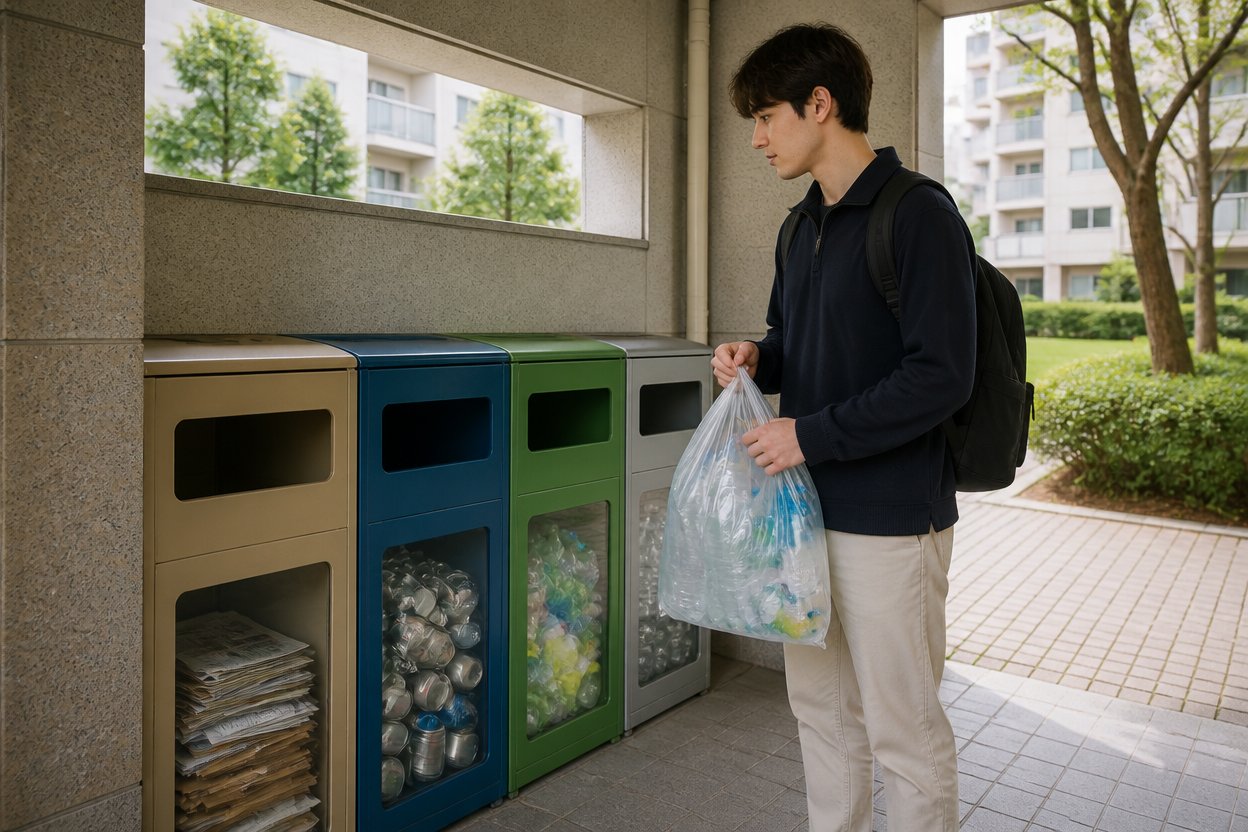
Garbage separation in Korea surprises almost every new resident.
You cannot throw everything into one bin: general trash goes into special paid bags sold for your district, food waste is collected separately, and recyclables are sorted by material.
Get it wrong and your bag may be left on the street with a warning sticker, and repeated violations can bring a fine.
This guide explains the basic system for international students, workers and families settling in.
Why is Korea so strict about trash?
Korea uses a volume-based waste fee system, called jongnyangje.
Instead of paying a flat garbage tax, you pay for general trash by buying official bags, so the less you throw away, the less you pay.
Recyclables put out correctly are collected without that bag fee, which is why people sort carefully.
The system is national, but each city district (gu) sets its own bags, days and details.
What are the three main types of household waste?
| Type | What goes in | How to put it out |
| General trash | Things that cannot be recycled or eaten: tissues, dirty wrappers, broken small items | In an official volume-based bag for your district |
| Food waste | Leftover food, fruit and vegetable scraps | In a food waste bag, bin or card-operated container, depending on your building |
| Recyclables | Paper, cans, glass, plastic, vinyl and clear PET bottles | Sorted by material, emptied and rinsed, at your building's recycling spot |
Where do I buy the official trash bags?
Volume-based bags are sold at convenience stores, supermarkets and neighborhood marts.
Ask for a jongnyangje bongtu and the size you want.
Bags are made for a specific district, so a bag bought in one gu may not be accepted in another.
If you move, buy new bags in your new district.
Prices differ by district and bag size, so check the price at the store.
What counts as food waste?
Food waste is anything an animal could eat: leftover rice, noodles, meat, fish, fruit peel and vegetable scraps.
Drain the liquid first.
Some things that look like food go in general trash instead, such as chicken and pork bones, fish bones, eggshells, shells from clams and crabs, onion skins, tea bags and hard fruit pits.
Lists vary a little by district, so check your district's guide if you are unsure.
Many apartments use a shared food waste bin with a card or a sticker; houses and studio buildings often use small food waste bags or containers.
How do I sort recyclables?
The basic rule is empty, rinse, remove labels and caps where possible, and sort by material.
1. Paper and cardboard: flatten boxes and remove tape. Dirty or wet paper goes in general trash.
2. Cans and metal: empty and rinse.
3. Glass bottles: empty them. Broken glass is not recycling; wrap it and follow your district's rule.
4. Plastics: empty and rinse containers.
5. Vinyl and plastic film: clean snack bags, wrappers and plastic bags, collected separately in many buildings.
6. Clear PET bottles: empty, remove the label, crush and close the cap. They are collected separately from other plastics.
Styrofoam is usually collected separately too, if it is clean and free of tape.
When and where do I put trash out?
In an apartment complex, there is usually a recycling area with labeled bins, and some days are fixed for certain items.
In houses, villas and one-room buildings, you often put bags out in front of the building on set days and times, usually in the evening.
Ask your landlord, building manager or neighbors, or look for a notice posted near the entrance.
Your district office website also lists collection days.
What about furniture and big items?
Large items such as furniture, mattresses and appliances are bulky waste.
You report them to your district, online or at the community center, pay a fee and attach the sticker or receipt number before putting the item out.
Some large appliances can be picked up for free through the national appliance collection service; check your district's guide.
Common mistakes new residents make
| Mistake | Why it is a problem | What to do instead |
| Using a regular plastic bag for trash | It is not an official bag | Buy your district's volume-based bag |
| Putting bones or eggshells in food waste | They are not food waste in most districts | Put them in general trash |
| Leaving liquid in bottles and food | It contaminates recycling | Empty and rinse first |
| Using a bag from another district | It may not be collected | Buy bags where you live |
Frequently asked questions
Can I throw everything into the general trash bag?
Recyclables and food waste should not go into general trash bags. Mixing them can lead to uncollected bags and fines.
Are the rules the same everywhere in Korea?
The basic system is national, but bags, days and some items differ by district. Always check your gu's guide.
Is there English information?
Many districts and the Seoul city website offer multilingual guides; your building notice board is also worth a look.
Moving into a small studio on your own? MARU looks at why more than a third of Korean homes have one person, and the corner store is where you will buy your first trash bags.
Sources: Ministry of Environment (me.go.kr) volume-based waste fee system and recycling separation guidelines; Seoul Metropolitan Government (seoul.go.kr) household waste disposal guide.


