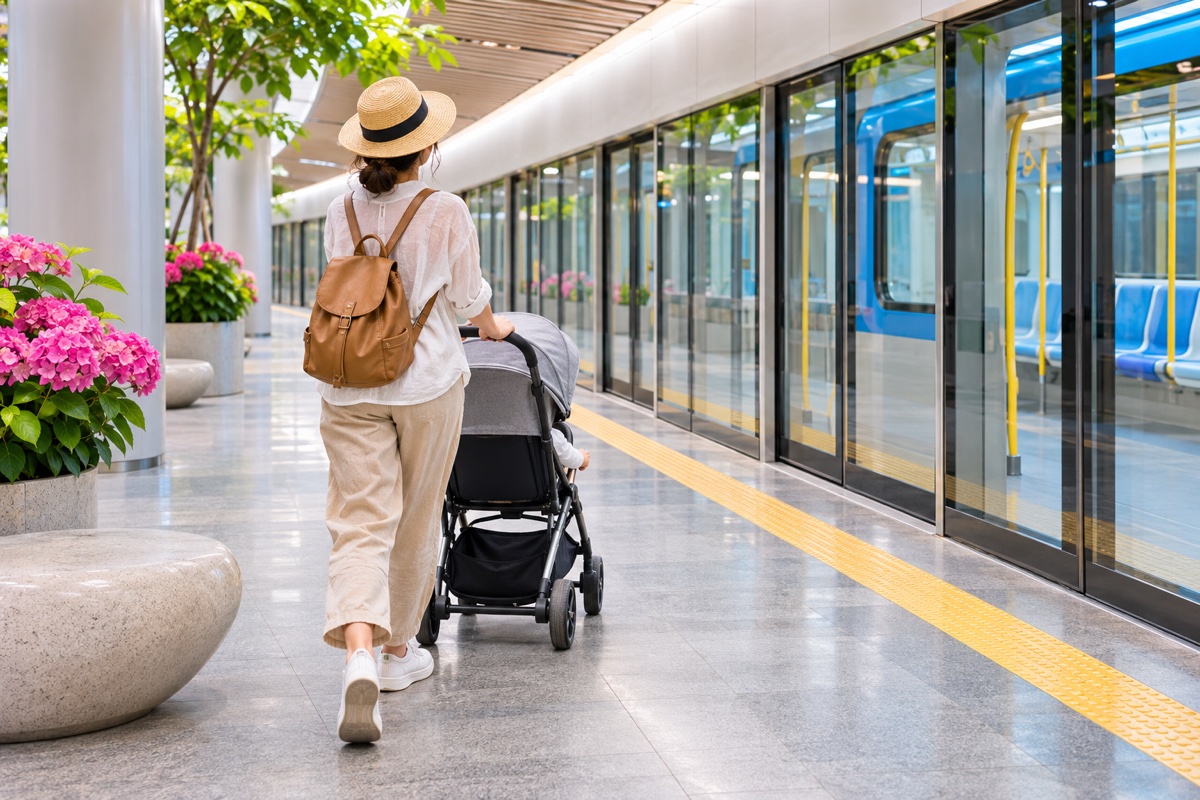
Yes, you can ride the Seoul subway with a stroller, and most days it is the easiest way to get around the city with a baby or toddler.
The trick is to plan your route around elevators, not around the shortest walk, and to avoid the 8–9 a.m. and 6–7 p.m. rush.
We are a family living in Seoul, and we have pushed everything from a heavy travel system to a cheap umbrella stroller through these stations.
This guide covers what actually helps on the ground: finding the lift exit, choosing a car, paying for kids, and the few stations where a stroller turns into a workout.
Are strollers allowed on the Seoul subway?
Strollers are allowed on every Seoul subway line, and you do not need to fold them on the train.
There is no stroller ticket and no extra charge.
You will see parents with strollers on almost every line during the day, and staff will not stop you at the gate.
What staff do ask is that you do not take a stroller on an escalator.
Station signs and announcements repeat this, and it is good advice: escalators in big stations are long and steep, and a stroller tipping backwards is a real accident risk.
So the whole game is elevators.
How do I find the elevator in a Seoul subway station?
Almost every Seoul subway station now has at least one elevator from street level to the platform, but it is often only at one or two exits.
That is the most common surprise for visiting families.
You come up the stairs at the exit closest to your hotel, and the lift is on the other side of a ten-lane road.
Here is how we find the right one before we leave:
1. In Naver Map or KakaoMap, search the station and open the station page. Exits with elevators are marked with a small lift icon.
2. On the platform, look for the yellow or green elevator signs on the pillars. They point to the car number closest to the lift.
3. Above ground, look for a glass elevator box on the sidewalk, usually a few meters from the exit stairs, not inside them.
4. If you cannot find it, the station office near the gates can tell you which exit has a lift. Saying «elevator» works; staff hear it every day.
| Situation | What to do | Why it helps |
| Planning the day | Check lift exits on Naver Map or KakaoMap | Exit numbers with lifts are not always the closest exits |
| On the platform | Board near the car shown on the elevator sign | Saves a long walk along a crowded platform |
| At the gates | Use the wide gate at the end of the gate row | Standard gates are too narrow for many strollers |
| Transferring lines | Follow transfer elevator signs, not the crowd | The crowd usually takes stairs or escalators |
| Rush hour | Ride before 8 a.m. or between 10 a.m. and 5 p.m. | Cars are packed and lifts have long lines |
Which gate and which car should I use with a stroller?
Every station has at least one wide gate, usually at the end of the row, sometimes marked with a wheelchair symbol.
Tap your card on that gate and it opens wider than the standard turnstile.
Inside the train, the best spot is the open area at the end of some cars, often next to the priority seats, where there are no seats in the way.
Lock the brakes and keep one hand on the handle.
Trains start and stop firmly, and an unlocked stroller rolls.
Watch the gap between the train and the platform at curved stations.
Lift the front wheels slightly as you cross, like stepping onto a curb.
How much do kids pay on the Seoul subway?
As of November 2026, the adult base fare with a transport card is 1,550 won.
Children aged 6 to 12 pay 550 won and youth aged 13 to 18 pay 900 won with a registered card.
Children under 6 ride free when they travel with a paying adult, up to three children per adult.
So a baby in a stroller costs nothing.
One catch for older kids: a T-money card only charges the child fare once it is registered with the child's age.
An unregistered card charges the adult fare, and we have watched more than one visiting family overpay for days without noticing.
| Rider | Fare with card (as of November 2026) | Notes |
| Adult (19+) | 1,550 won | Base fare for about 10 km |
| Youth (13–18) | 900 won | Card must be registered |
| Child (6–12) | 550 won | Card must be registered |
| Under 6 | Free | Up to 3 children with a paying adult |
Which Seoul stations are hard with a stroller?
Big transfer stations are the toughest, simply because of distance and crowds.
Seoul Station, Jongno 3-ga, Express Bus Terminal, Gangnam and Hongik University are all stations where we budget ten extra minutes.
The lifts exist, but you may need two or three of them in a row, and each one can have a queue of older riders, wheelchairs and other parents.
Please let older people and wheelchair users go first when the lift is small.
Locals notice, and it makes everyone friendlier to the next stroller.
Some older stations near the palaces and markets have only one lift exit.
If you are visiting Gyeongbokgung, for example, check the lift exit before you go instead of following the tour crowd to the nearest stairs.
Is a big stroller or a small one better for Seoul?
For a short trip, a light, compact stroller that folds with one hand is much easier.
Seoul sidewalks are mostly good, but you will meet steep side streets, small shop doors, café stairs and crowded markets.
Our big stroller lived in the car.
Our cheap foldable one did the subway, buses, cafés and palaces.
If your child is young enough, a baby carrier plus a small stroller is the combination we see most often among local parents on the train.
What about buses and taxis with a stroller?
City buses in Seoul are harder than the subway.
Many routes now use low-floor buses, but they are crowded and the driver pulls away quickly.
With a stroller, we only take a bus when it is quiet, and we fold the stroller when it is busy.
For taxis, most cars have room for a folded compact stroller in the trunk.
If you have a large stroller, ask for a larger taxi in the app before you book.
Can I take a stroller into Seoul cafés, palaces and museums?
Most big museums in Seoul lend strollers or have ramps and lifts throughout.
Palaces have gravel and stone paths that rattle small wheels but are fine for a sturdy stroller.
Small cafés are the tricky part: many are up a flight of stairs or in a basement.
In neighborhoods like Seongsu or Ikseon-dong, we pick cafés with ground-floor doors, which you can usually see in the map photos.
Department stores and large malls are the stroller-friendliest places in Seoul, with nursing rooms, diaper tables and wide lifts.
When we need a break with a baby, that is where we go.
Frequently asked questions
Do I need to fold my stroller on the Seoul subway?
No. You can keep it open, but stand in a corner or open area and lock the brakes. Fold it when the car is very crowded.
Can I use the escalator with a stroller in Korea?
Stations ask you not to. Use the elevator, even if it means walking to a different exit.
Does a baby need a ticket on the Seoul subway?
No. Children under 6 ride free with a paying adult, up to three children per adult.
What is the best time to ride with a stroller?
Between about 10 a.m. and 5 p.m. on weekdays. Weekends are busy in the afternoon around shopping areas.
If you are planning slower days around the city with little ones, MARU has a good read on Seoul's Han River parks, which are wide, flat and perfect for strollers, and on why everything in Korea moves so fast, which explains a lot about subway crowds.
Sources: Seoul Metro (seoulmetro.co.kr) fare and station guides; Korea Herald, «Seoul subway fares to increase to 1,550 won starting June 28» (2025); Visit Korea (english.visitkorea.or.kr).
'Transport' 카테고리의 다른 글
| T-money Card for Kids in Seoul: How to Register the Child Fare (0) | 2026.11.05 |
|---|---|
| How to Get from Incheon Airport to Myeongdong, Seoul (1) | 2024.09.19 |

