International students can work in Korea, but not on the visa alone.
A D-2 student needs a part-time work permit from immigration before the first shift, and the weekly limit depends on your degree level and Korean ability: with the required TOPIK level, undergraduates can work up to 25 hours on weekdays and graduate students up to 30, as of November 2026.
Without the language level, the limit drops sharply.
Students in our neighborhood have lost visa options over a few unreported shifts at a restaurant, so this is one rule to take seriously.
Permission depends on your school record and personal situation, so confirm your own case with your international office or the 1345 call center.
How many hours can a D-2 student work in Korea?
The limits below are the ones published by university international offices from the Ministry of Justice guidelines.
| Program | Korean level required | Without it (per week) | With it (weekdays) | Weekends, holidays, vacations |
| Associate degree | TOPIK 3 | 10 hours | 25 hours | No hour limit |
| Bachelor's, years 1 and 2 | TOPIK 3 | 10 hours | 25 hours | No hour limit |
| Bachelor's, years 3 and 4 | TOPIK 4 | 10 hours | 25 hours | No hour limit |
| Master's and doctoral | TOPIK 4 | 15 hours | 30 hours | No hour limit |
| D-4 language trainee | TOPIK 2 | 10 hours | 20 hours | Same weekly limit applies |
These are the figures as of November 2026.
Students who meet extra conditions, such as attending a government-certified university or holding a higher Korean level, can be given five more weekday hours.
The final number is whatever your permit says, not the top line of a table.
If you work at two places, the hours are added together.
What counts as the required Korean level?
TOPIK is the usual proof.
Completion of the matching stage of the Korea Immigration and Integration Program, or the matching King Sejong Institute course, is accepted in its place.
Students in English-taught programs can submit an English score, with TOEFL iBT 71 or IELTS 5.5 given as the standard by universities.
If you have no language proof at all, you can still apply, but the 10 or 15 hour limit includes weekends.
That alone is a good reason to sit TOPIK early.
Who can apply, and who gets refused?
You must hold a valid D-2 status and be enrolled.
Universities check your record before signing the form, and the common bar is a GPA of at least 2.0 in the previous semester and adequate attendance.
D-4 language trainees have to wait six months from entry before they can apply.
Undergraduates in extra semesters are often excluded.
Work as a campus teaching assistant or on a work-study scholarship normally needs no permit, but ask your office to be sure.
Which jobs are allowed, and which are off limits?
The permit is meant for ordinary student jobs.
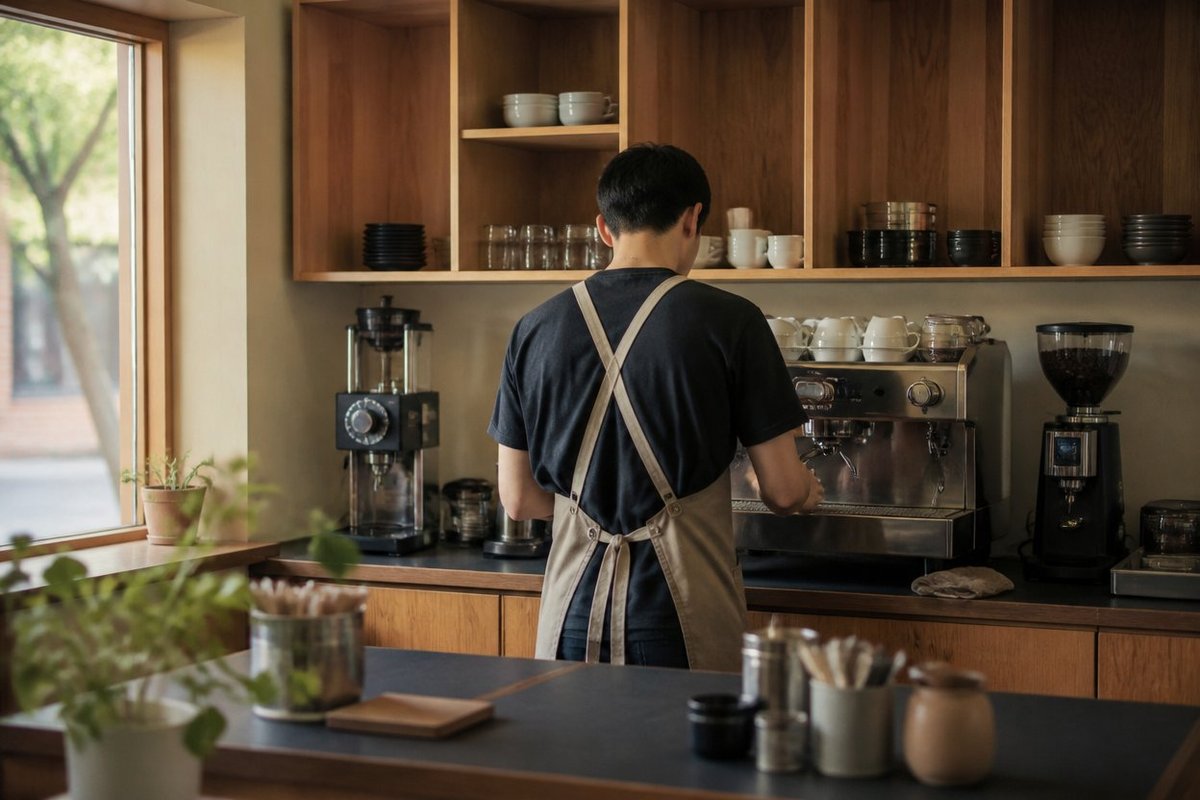
Restaurant and cafe work, convenience store shifts, office assistance, translation, interpreting, event staff and tutoring-type work in your own language are the typical cases.
Construction is off limits, and manufacturing is restricted.
University notices are blunt about it: a student caught on a construction site can be ordered to leave on the first violation.
Jobs in adult entertainment venues are not permitted.
Delivery riding and platform work raise separate questions about contracts and insurance, so ask immigration before you start.
What documents do I need for the part-time work permit?
You prepare some, your employer prepares some, and your school confirms the set.
| Document | From | Note |
| Integrated application form | HiKorea | Tick permission for activities outside your status |
| Passport and Residence Card | You | Originals for a visit, scans for online |
| Part-time work confirmation form | School template, signed by employer and school | The form changed in 2026, so use the current one |
| Standard labor contract | Employer | Must show hourly wage, duties and hours |
| Copy of business registration | Employer | Shows the type of business |
| Copy of employer's ID | Employer | Asked for by many offices |
| Certificate of enrollment and transcript | School | Shows status and GPA |
| Korean ability certificate | You | TOPIK or an accepted alternative |
How do I apply on HiKorea?
First find the job and sign the labor contract, with a start date that leaves time for the permit.
Fill in the part-time work confirmation form and have the employer sign or stamp it.
Take it to your international office for the school's confirmation.
Then apply through the HiKorea e-application, or book a visit reservation and go to your immigration office.
Wait for the approval before you work a single hour.
A permit covers a named workplace for up to one year, and students are limited to two workplaces at a time.
If you change jobs, report the new workplace within 15 days.
How much should I be paid?
Foreign students are covered by the same minimum wage as everyone else.
The minimum wage for 2026 is 10,320 won per hour, set by the Ministry of Employment and Labor.
If you work 15 hours or more a week, labor law also gives you a paid weekly rest allowance on top of the hourly pay.
Ask for a written contract and a pay slip.
An employer who wants to pay cash with no contract is also an employer who will not sign your permit form, and that should tell you enough.
If wages go unpaid, the Ministry of Employment and Labor takes complaints through its 1350 call center and local labor offices.
Convenience stores are the classic student workplace, and MARU's piece on Korean convenience store culture shows why there are so many of them hiring.
What happens if I work without a permit?
It is treated as a violation of the Immigration Act.
Penalties range from a fine to limits on your next extension, and repeated or serious cases can end in an order to leave.
University notices also warn that students who worked without permission can be blocked from changing to a job-seeking visa after graduation.
Working more hours than the permit allows counts as a violation too.
Employers are punished as well, which is why careful ones ask to see your permit.
What helped the students we know stay out of trouble?
They took TOPIK in their first year.
They told the employer on day one that the paperwork takes time and that they could not start before approval.
They kept a simple log of hours on their phone.
They reported a job change the same week.
And they picked workplaces close to school, since cafe shifts between classes are easier to keep within the limit; if you end up behind a counter, MARU's guide to Korean cafe etiquette is useful background.
Frequently asked questions
Can I work in my first semester?
D-2 degree students have no waiting period, though without the required Korean level the limit is 10 hours a week for undergraduates.
Can I work full time during vacation?
D-2 degree students who meet the Korean requirement have no hour limit during vacations, weekends and public holidays, but the permit itself is still required.
Do I need a new permit for each job?
Yes, the permit names the workplace, and a change must be reported within 15 days.
Does tutoring English privately count?
Paid work of any kind needs to fit your permit, and private tutoring has its own rules, so ask 1345 before taking it.
Is the D-4 rule the same?
No, D-4 language trainees wait six months and keep the same weekly limit on weekends and vacations.
Sources: HiKorea (hikorea.go.kr) permission for part-time work by international students; Kwangwoon University and Hankuk University of Foreign Studies international office notices (2026); Ministry of Employment and Labor (moel.go.kr) 2026 minimum wage notice; Easy to Find, Practical Law (easylaw.go.kr).
'Visa & ARC' 카테고리의 다른 글
| How to Extend a D-2 Student Visa on HiKorea: Documents, Fee and Timing (0) | 2026.11.15 |
|---|---|
| How to Apply for a Residence Card (ARC) in Korea: HiKorea Reservation, Documents and Fee (0) | 2026.11.14 |

